

Solar Plexus Chakra Guide to Balance Confidence
Solar Plexus Chakra Guide to Balance Confidence

Content
Content
A grounded, practice-ready guide to reclaiming confidence, willpower, and inner fire.
Created by a certified yoga teacher and wellness editor drawing on a decade of breathwork, meditation, and somatic practice. Every recommendation below connects yogic tradition with current stress-response science.
What Is the Solar Plexus Chakra?
Positioned third in the classical seven-chakra map, the solar plexus chakra occupies the space where instinct meets intention. Yogic and tantric lineages call it Manipura — roughly, “shining jewel” — and locate it in the upper belly, between navel and sternum. Below it: the sacral center of emotion and desire. Above: the heart’s domain of compassion. Manipura bridges the two, converting raw feeling into directed action.
Whenever you hear “go with your gut,” that phrase lands squarely in Manipura territory. The chakra maps almost exactly onto the digestive organs that process not just food, but also the low-grade signals your body sends about safety, readiness, and resolve.
Quick overview: Manipura controls willpower, self-identity, decisiveness, and healthy ego. When it functions well, you feel purposeful and grounded. When it’s suppressed, passivity and self-doubt dominate. When it runs hot, control and burnout follow. The remedy blends breathwork, core-focused yoga, affirmations, visualization, and daily acts of self-advocacy.
Manipura Chakra Meaning (Stripped Down)
Forget the mystical overlay for a moment. At its simplest, Manipura reflects how you handle your own agency. Can you decide without agonizing? Say “no” without spiraling into guilt? Receive criticism without collapsing? Sit with disagreement without either caving or attacking?
That’s the spectrum. On one end: “Whatever you think is best” (deflated Manipura). On the other: “I’ve considered it — here’s my position” (healthy Manipura). No swagger. No domination. Just a dependable internal compass that doesn’t waver every time someone frowns.

Author: Lily Patterson;
Source: yogapennsylvania.com
Core Attributes at a Glance
| Property | Description |
| Position | Upper abdomen — navel to lower ribs |
| Element | Fire (Agni) |
| Color | Warm, vivid yellow |
| Bija Mantra | RAM (“rahm”) |
| Linked Organs | Stomach, pancreas, liver, adrenal glands, small intestine |
| Central Theme | Autonomy, willpower, identity, purposeful action |
Fire is the operative metaphor. It transforms and digests — both literally (your GI tract clusters here) and psychologically. “Fired up” and “burned out” aren’t random idioms; they describe the two extremes of this center.
How a Healthy Solar Plexus Chakra Shows Up
Balance here isn’t perpetual motivation or unshakeable bravado. That’s a caricature. Real balance is quieter and far more functional.
Practical Signs of a Well-Tuned Manipura
- Disagreeing with someone you admire without your stomach knotting.
- Approaching deadlines with focus instead of dread.
- Completing projects because they align with your values — not because you need applause.
- Registering a mistake as a lesson, not a verdict on your character.
- Admitting uncertainty without interpreting it as incompetence.
- Remaining steady when someone around you is angry, without either folding or escalating.
Physically, steady Manipura shows up as more reliable digestion, fuller breathing during moderate pressure, and fewer late-night mental reruns of awkward exchanges.
Simple test: recall a recent group setting where your opinion was the minority. Did you share it anyway? Could you hold it without needing to convert anyone? If yes — Manipura is online.
Recognizing Blocked Solar Plexus Chakra Signs (Plus Overactive Patterns)
Imbalance swings two ways. An underactive center starves you of drive. An overactive one floods you with compulsive control. Many people oscillate depending on context — passive at home, domineering at work, or the reverse.
Underactive vs. Overactive Comparison
| Area | Underactive | Overactive | First Step |
| Emotions | Powerlessness, persistent doubt, shame | Short fuse, compulsive control, impatience | Two-minute emotional journal each morning |
| Behavior | Dodging decisions, over-accommodating | Overcommitting, refusing delegation | Practice one weekly boundary conversation |
| Physical | Slow digestion, tiredness, slouching | Heartburn, clenched jaw, nervous restlessness | 4-count box breath — four rounds minimum |
| Inner Voice | “Who am I to do that?” | “No one does it right but me.” | Replace one distorted thought daily with an affirmation |
| Relationships | Can’t refuse requests; quiet resentment grows | Steamrolls discussions; partners withdraw | Lead with “What do you need?” before jumping to solutions |
Self-assessment shortcut: Review three recent choices. Avoided them entirely? Underactive pattern. Bulldozed through without input? Overactive pattern. Weighed, chose, moved on? Balanced.
Health and Safety Reminder
Important: These practices complement professional care — they don’t replace it. Ongoing anxiety, clinical depression, eating disorders, unrelenting fatigue, or gastrointestinal conditions need a licensed provider. For urgent mental health support, call or text 988 (Suicide & Crisis Lifeline).
How to Balance the Solar Plexus Chakra: A Three-Step Method
Restoring equilibrium here isn’t a weekend project. It’s a series of manageable, stackable habits that quietly reconstruct your relationship with personal authority. The sequence below starts where it should — your nervous system — then moves outward.
Step One: Settle the Nervous System (Breathwork)
A common misstep: reading about energy blockages, panicking slightly, then attacking the problem with aggressive core drills or shouted mantras. If your system is already revved, intensity makes things worse. Calm first, activate second.
- Box Breath (4-4-4-4): Four counts inhaling, four holding, four releasing, four empty. Run four to six cycles. This technique balances excitatory and calming nervous-system branches. Military operators use it under fire — pure physiology, zero mysticism.
- Long Exhale (4-7): Inhale four counts; release over seven. That extended outbreath stimulates the vagus nerve, which threads directly through the solar plexus zone. Six to eight cycles. Ideal before confrontations or public speaking.
- Kapalabhati (Breath of Fire): Rapid, pumping exhales through the nostrils; inhales happen passively. Twenty to thirty pulses, then pause. Generates internal heat and sharpens focus. Skip during pregnancy, uncontrolled blood pressure, or active panic.
A 2018 study in Frontiers in Psychology confirmed that controlled slow breathing measurably drops cortisol and subjective anxiety scores. You don’t have to subscribe to chakra theory for diaphragmatic breathing to lower your stress chemistry.
Step Two: Accumulate Evidence of Capability (Small Wins)
Self-assurance isn’t a mindset you install. It’s a conclusion your brain draws from repeated proof. Manipura responds to stacked micro-accomplishments, not dramatic gestures.
In order to succeed, people need a sense of self-efficacy — the belief that they can exert control over their own functioning and over events that affect their lives.
— Albert Bandura
Three-Tier Action Ladder:
- Tier 1 (Minimal resistance): Reply to that lingering email. Pick tonight’s meal without polling anyone. Complete one item before unlocking your phone.
- Tier 2 (Moderate resistance): Turn down a social obligation that drains you. Cap a meeting at its scheduled end time. Answer “How are you?” honestly.
- Tier 3 (Significant resistance): Address an unresolved tension directly. Negotiate compensation. Quit a commitment that contradicts your priorities.
Ready-made boundary phrase: “That won’t work for me, but here’s what I can offer.” Example: “I can’t cover Saturday, but I’m available Monday morning.” No apology. No lengthy justification. A clear counter-offer.
Albert Bandura’s self-efficacy research demonstrates that successfully completing progressively harder tasks is the most potent confidence-builder known to psychology. Visualization helps. Affirmations help. But nothing substitutes for doing the thing and surviving intact.
Step Three: Stack a Daily 10-Minute Ritual
- Breathing (2 min): Box breath or extended exhale — match technique to your current energy.
- Affirmation (1 min): One spoken statement after a full exhale. (Details in the affirmation section.)
- Visualization (5 min): Golden warmth expanding at the upper belly. (Script below.)
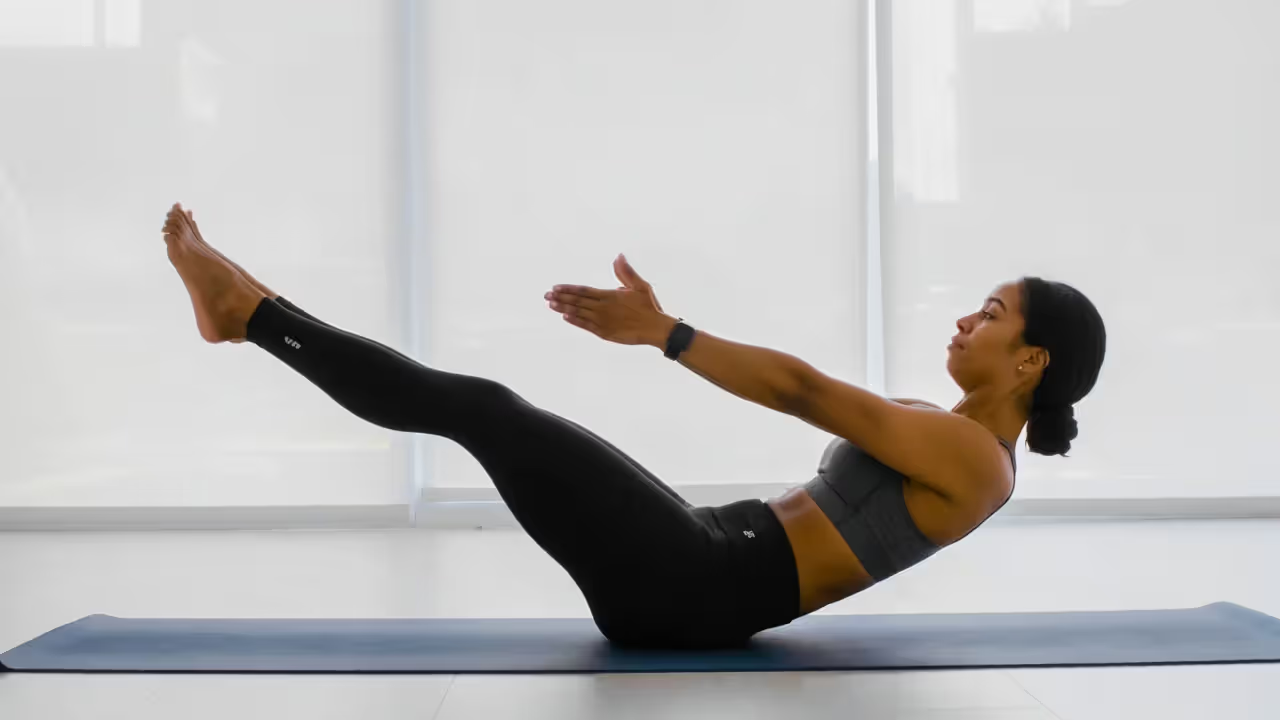
- Single Pose (2 min): Boat or Warrior III. Attention on the midsection, not on aesthetics.
Short on time? Drop the pose. Desperately short? Just breathe for two minutes. Incomplete practice still registers.
Solar Plexus Chakra Meditation: A 7-Minute Guided Session

Author: Lily Patterson;
Source: yogapennsylvania.com
The Script
Sit comfortably — chair, cushion, floor. Rest your palms on your upper belly or your lap.
0:00–2:00 — Shut your eyes gently. Draw three progressively slower breaths, each exhale longer than the last. Let awareness drop from your skull into your trunk. Register the belly’s quiet motion.
2:00–4:00 — Focus on the zone between navel and ribcage. Picture a steady golden glow there — not a flash, more like afternoon light filtering through curtains. Each inhale widens it a fraction. Each exhale firms it up. Nothing theatrical. Quiet warmth.
4:00–6:00 — Layer silent phrases onto the rhythm. Inhale: “I can.” Exhale: “I choose.” Let the words sync with the light. Thoughts will intrude — expected. Simply return to the glow and the cues without commentary.
6:00–7:00 — Drop the image and the words. Sit with residual sensation — warmth, stillness, energy, or nothing at all. Each outcome is fine. One last deep breath, then open your eyes and reorient to your surroundings before standing.
Pitfalls and Corrections
- Trying to manufacture a feeling: The goal isn’t production — it’s observation. Noticing absence of sensation is equally valid data.
- Reserving meditation for emergencies only: Five steady minutes on an uneventful Wednesday outperform twenty frantic minutes before a high-stakes meeting. Maintenance beats crisis intervention.
- Anticipating instant transformation: Confidence eroded over years. Rebuilding takes weeks of consistent reps, not a single session. Expect subtle shifts around the two-to-three-week mark.
The ability to pause and not act on the first impulse has become one of the key learnings of life.
— Viktor Frankl
Solar Plexus Chakra Affirmations: Confidence and Boundary-Setting
Twelve Statements — Choose Three, Commit for One Week
- I have confidence in my own judgment.
- My limits safeguard both my energy and my connections.
- Courage and uncertainty coexist in me — and I move forward anyway.
- Claiming space is my right, not an imposition.
- How I allocate my hours is my decision.
- My value exists independent of my output.
- Difficult conversations are within my range.
- What lies outside my influence, I release.
- I own a voice worth hearing, and I use it.
- Gaps in my knowledge are invitations, not indictments.
- Walking away from harm is an act of self-respect.
- No one’s blessing is required for me to chase what matters.
Select the three that provoke slight discomfort — a tightening, a flash of “yeah, right.” That resistance marks the exact belief under renovation. Comfortable affirmations aren’t doing heavy lifting.
Making Affirmations Land
- Speak at the exhale’s floor: The parasympathetic window at breath’s end makes your system more receptive. Exhale completely, then voice the phrase aloud. The body processes spoken words differently from silently scanned text.
- Attach an action: Declaring “Difficult conversations are within my range” means little unless you initiate one that week. The statement opens possibility; behavior converts it to lived experience.
- Log confirming evidence: Note each instance where the affirmation proved accurate — a refused request, a voiced opinion, a kept promise. Seven days of entries give your brain pattern-level proof, which it weighs far more heavily than repetition.
Solar Plexus Chakra Yoga Poses: Core Strength and Internal Heat
Author: Lily Patterson;
Source: yogapennsylvania.com
Recommended Poses
| Pose | Primary Target | Easier Variation | Watch Out For |
| Boat (Navasana) | Deep abdominals, hip flexors | Bent knees; grip behind thighs | Lower-back sensitivity; not during pregnancy |
| Plank | Global stability, sustained core load | Knees down, spine neutral | Wrist strain — switch to forearms |
| Warrior III | Single-leg balance, midline integration | Blocks under hands; rear foot against wall | Unstable ankles — use wall support |
| Chair (Utkatasana) | Quadriceps, abdominal brace, heat | Shallower bend; hands at chest | Knee discomfort — reduce depth |
| Bow (Dhanurasana) | Front-body opening, solar plexus expansion | One leg at a time | Pregnancy or recent abdominal surgery |
| Reclined Twist | Rotational core, digestive support | Keep both shoulders pinned | Disc issues — clear with a physical therapist |
10-Minute Manipura Sequence
- Warm-Up (2 min): Cat-Cow for eight rounds. Inhale into extension; exhale rounding. Let the abdomen swell and contract fully.
- Core Load (3 min): Plank — 30 sec. Pause 10. Boat — 30 sec. Pause 10. Second round.
- Standing Power (3 min): Chair — five breaths. Step into Warrior III right — five breaths. Return to Chair. Warrior III left — five breaths.
- Wind-Down (2 min): Reclined twist, five breaths per side. Finish supine, hands on upper belly, three slow rounds of breath.
Perspiration isn’t the objective. Deliberate midsection engagement paired with measured breathing is. If you catch your jaw locking, soften it. Direct effort to the center, release it everywhere else.
Lifestyle Reinforcements: Habits, Nourishment, and Optional Rituals
Off-the-Mat Confidence Builders
- Morning “one uncomfortable action”: Name it before breakfast. Execute by bedtime. Not epic — just slightly outside comfort. Book the appointment. Pitch the idea. Draw the line. Check it off.
- Honor every yes: Agree only to what you genuinely intend to deliver. Each unkept self-promise chips at Manipura. Each honored one reinforces it. Uncertain? Default to “I’ll get back to you” rather than an automatic nod.
- Morning light: Ten to fifteen minutes outdoors within the first hour of waking. Sunlight calibrates cortisol rhythm and mood circuitry. Not folklore — photobiology.
- Yellow-spectrum foods (low-key, optional): Ginger, turmeric, banana, corn, chamomile. Traditional color-matching aside, these items support digestive function, which maps directly onto solar plexus territory.
Supplementary Practices (Take or Leave)
- Stones: Citrine, tiger’s eye, yellow jasper. Lay one on your abdomen during visualization or pocket it as a tactile anchor. Your focused attention does the work; the stone is a prop.
- Scent: Lemon, bergamot, ginger, peppermint. Diffuse during seated practice or dab diluted oil on wrists. Over time, the aroma becomes a shortcut into the meditative state.
- Written reflection: Prompts: “Where did I surrender authority today?” / “What choice am I dodging — and what fear drives the avoidance?” / “One courageous act from this week.” Five minutes, unedited stream.
7-Day Solar Plexus Rebalancing Schedule
Budget ten to twenty minutes daily. Skipping a day doesn’t erase progress — just resume tomorrow.
Day 1 — Grounding
- Breath: Box method, four cycles
- Statement: “I have confidence in my own judgment.”
- Posture: 30-second plank
- Boundary move: Respond “Let me consider that” once instead of auto-agreeing
- Journal: “Where does my confidence feel strongest? Where does it vanish?”
Day 2 — Breath and Movement
- Breath: Long exhale (4-7), six cycles
- Statement: “My limits safeguard my energy.”
- Posture: Boat, twice for 30 seconds
- Boundary move: Wrap up a conversation on your timing, not theirs
- Journal: Record one gut-instinct moment you honored today
Day 3 — Visualization Focus
- Meditation: Complete 7-minute session
- Statement: “Courage and uncertainty coexist in me.”
- Posture: Warrior III, five breaths each leg
- Boundary move: Refuse one obligation that doesn’t serve you
- Journal: “What am I putting up with that I shouldn’t be?”
Day 4 — Execution
- Breath: Kapalabhati, two sets of 20 (if appropriate)
- Statement: “Gaps in my knowledge are invitations.”
- Posture: Chair, five breaths x three sets
- Action: Tackle one Tier 2 item from the ladder
- Journal: Describe the action and your state afterward
Day 5 — Full Flow
- Movement: Complete 10-minute Manipura sequence
- Statement: “How I allocate my hours is my decision.”
- Boundary move: Time-box a task; stop when the clock runs out
- Journal: “Am I running cool or hot today? What does that signal?”
Day 6 — Restoration
- Breath: Long exhale, eight cycles
- Statement: “My value exists independent of my output.”
- Lifestyle: Morning sun, 10 min. One yellow-spectrum food. Diffuse lemon during practice.
- Boundary move: Rest openly — no excuse offered to anyone, yourself included
- Journal: “If I fully accepted I was enough, what shifts?”
Day 7 — Review and Commit
- Meditation: 7-minute script plus 3 minutes silent
- Statement: Repeat the week’s toughest affirmation three times
- Posture: Whichever pose resonated most this week
- Review: Reread all journal entries. Highlight patterns. Name three boundary or courage wins.
- Next step: Select one element to carry into Week 2.
Frequently Asked Questions
Sustaining Your Inner Fire
Manipura isn’t a switch you flip to unlock fearless confidence. It’s a lens for examining how you relate to your own agency, your limits, and your presence in the world.
One takeaway above all: personal power accumulates through ordinary, repeated choices — not peak experiences. A single clear “no.” A thirty-second plank held with intention. One moment of trusting your read of a situation instead of deferring to everyone else’s. These micro-decisions, stacked across weeks and months, reshape the way you occupy your own life.
The flame at your center doesn’t require a blaze. It only requires that you keep it burning.
Related Stories

Read more

Read more



The content on yogapennsylvania.com is provided for general informational and inspirational purposes only. It is intended to share yoga tips, meditation practices, wellness guidance, retreat experiences, and lifestyle insights, and should not be considered medical, therapeutic, fitness, or professional health advice.
All information, articles, images, and wellness-related materials presented on this website are for general informational purposes only. Individual health conditions, physical abilities, wellness goals, and experiences may vary, and results can differ from person to person.
Yogapennsylvania.com makes no representations or warranties regarding the accuracy, completeness, or reliability of the content provided and is not responsible for any errors or omissions, or for decisions or actions taken based on the information presented on this website. Readers are encouraged to consult qualified healthcare or wellness professionals before beginning any new yoga, meditation, or fitness practice.