
Yoga Retreat Guide to Practice Healing Community

Content
Content
There is a moment, usually around the third morning of a yoga retreat, when something shifts. The persistent hum of daily obligations that followed you onto the plane has finally quieted. Your body has stopped bracing against invisible deadlines. The mental tab you kept open for work emails has, without your conscious permission, closed itself. You find yourself standing on a mat in some sunlit room or open-air pavilion, genuinely uncertain what day it is, and for the first time in months—perhaps years—this disorientation feels like relief rather than failure. This is not vacation. This is not escape. This is the beginning of transformation, and it operates according to principles that neuroscience, psychology, and contemplative traditions have been documenting with increasing precision.
The yoga retreat as a contemporary phenomenon carries enormous variation in quality, intention, and depth. Some retreats offer little more than scenic backdrops for Instagram content and comfortable beds between casual asana classes. Others create carefully designed containers for genuine psychological and physiological change—environments where the accumulated tension of modern life can finally discharge, where patterns that seemed immutable reveal themselves as merely habitual, and where participants discover capacities for presence, resilience, and self-understanding they had forgotten they possessed. Understanding what distinguishes superficial relaxation from authentic transformation helps you choose experiences wisely and approach them with the openness that allows their full potential to unfold.
Research from the National Center for Complementary and Integrative Health confirms that yoga practices produce measurable effects on stress hormones, inflammatory markers, and autonomic nervous system function, with benefits that compound when practice occurs consistently within supportive environments. The retreat setting amplifies these effects by removing the competing demands and chronic stressors that normally fragment attention and maintain the body in low-grade sympathetic activation. Transformation, it turns out, requires not just the right practices but the right conditions—and a well-designed yoga retreat provides both simultaneously.
The modern hunger for retreat experience reflects something deeper than the wellness industry's marketing success. It points toward a genuine deficit in contemporary life—the absence of structured time for reflection, the scarcity of environments that support nervous system recovery, the rarity of communities organized around shared intention rather than mere proximity or professional obligation. The retreat meets needs that ordinary life increasingly fails to address, which explains why people return from these experiences not merely rested but fundamentally altered in their relationship to themselves, their bodies, and their daily existence.
The Psychology of Stepping Away From Daily Life
The most underappreciated aspect of retreat experience involves the simple act of physical removal from your ordinary environment. Your home, your office, your commute, your neighborhood—these spaces carry accumulated associations that constantly trigger habitual thoughts, emotions, and behaviors without your conscious awareness. The kitchen counter where you always check your phone. The chair where you typically ruminate about work problems. The bedroom where anxiety visits you at three in the morning. These environmental cues operate beneath conscious perception, automatically activating patterns you might genuinely wish to change but cannot seem to interrupt when surrounded by the stimuli that continually reinforce them.
Geographic displacement interrupts this automated cycling. When you wake in an unfamiliar room, walk unfamiliar paths, and encounter unfamiliar faces, your nervous system must engage more consciously with your surroundings rather than running on autopilot. This heightened engagement, while initially requiring more energy, creates an opening for new patterns to establish themselves in the absence of old triggers. The American Psychological Association has published research on how environmental novelty supports cognitive flexibility and how removal from chronic stressors allows the parasympathetic nervous system to reassert itself after prolonged suppression.
The psychological concept of attention restoration explains another dimension of why retreat settings facilitate change. Your daily environment demands constant directed attention—filtering relevant from irrelevant information, inhibiting distractions, maintaining focus on tasks that may not intrinsically interest you. This directed attention fatigues over time, producing the mental exhaustion that characterizes modern burnout. Natural environments and simplified schedules allow a different mode of attention to emerge: soft fascination, where awareness rests gently on phenomena that engage without demanding—flowing water, rustling leaves, the play of light through windows. This attentional rest restores the cognitive resources necessary for the deeper work that retreat practices invite.
The temporal dimension of stepping away deserves consideration as well. Modern life operates according to external schedules that rarely align with internal rhythms—alarm clocks that interrupt sleep cycles, meeting times that ignore energy fluctuations, deadlines that demand productivity regardless of biological readiness. Retreats often allow more organic timing, with schedules designed around optimal practice windows and sufficient rest rather than around productivity maximization. This alignment between external structure and internal rhythm produces a coherence that many participants have not experienced since childhood, if ever, and this coherence alone generates significant healing independent of any specific practice or intervention.
The phenomenon of liminality—the psychological state of being betwixt and between, neither in one's ordinary life nor fully elsewhere—characterizes the retreat experience and contributes to its transformational potential. Anthropologists have long recognized that liminal states, traditionally accessed through ritual and ceremony, create conditions where identity becomes fluid and change becomes possible in ways that ordinary circumstances resist. The retreat functions as a contemporary liminal container, temporarily suspending the social roles, professional identities, and habitual self-concepts that normally constrain who you understand yourself to be and who you might become.
Daily Yoga and Meditation as a Structured Container
The yoga practice you squeeze into your regular schedule—forty-five minutes before the household wakes, an evening class rushed to after work—differs qualitatively from the same practice embedded within a retreat container. This difference operates through several mechanisms that transform occasional exercise into genuine contemplative training, creating conditions under which the neurological and psychological benefits of yoga can fully mature rather than remaining superficial stress relief that evaporates within hours of practice ending.
Rhythm establishes the first transformational mechanism. When you practice at the same times each day for multiple consecutive days, your body begins anticipating these sessions, preparing physiologically for the work before it begins. Cortisol patterns shift. Sleep architecture reorganizes around the daily schedule. The nervous system learns to drop into parasympathetic states more readily because it recognizes the contextual cues that signal practice time. This rhythmic consistency, difficult to maintain amid the chaos of ordinary life, occurs automatically within retreat structure—someone else has designed the schedule, removed the decisions, and created the container that supports your practice without requiring you to simultaneously create and occupy it.
Repetition deepens the second mechanism. The cumulative effect of practicing daily—sometimes multiple times daily—over a week or two exceeds what the same total hours would produce if distributed across months of irregular sessions. Skills integrate. Postures that felt effortful become accessible. Breathing patterns that required conscious attention begin occurring spontaneously. The body learns in ways that isolated practice cannot achieve because learning requires not just exposure but repetition within timeframes that allow neural consolidation to occur. Educational resources from Yoga Journal discuss how immersive practice environments accelerate skill acquisition and deepen the mind-body connection that distinguishes transformational yoga from mere physical exercise.
Accumulated duration creates the third mechanism. Most regular practitioners never experience what happens when you simply continue practicing beyond the point where daily sessions normally end. The first twenty minutes release surface tension. The next twenty access deeper holding patterns. Beyond that, something else emerges—a quality of presence and bodily awareness that requires extended practice to contact and that reveals itself only when you stop looking at the clock, stop planning your post-practice activities, and simply remain in the process until the process itself completes.
The container provided by retreat structure also protects practice from the interference that normally fragments it. At home, you might begin a session only to be interrupted by a phone call, a family member's need, or your own sudden remembering of some urgent task. These interruptions prevent the deepening that extended unbroken practice allows, keeping you perpetually in the shallow end of the contemplative pool. The retreat environment—with its social norms against interruption, its removal of devices, its explicit prioritization of practice over all competing demands—provides the protected time that deep practice requires but that ordinary life rarely offers.
The progression of practice across retreat days follows a recognizable arc that regular practitioners seldom experience. The first day often involves resistance, restlessness, and the surfacing of accumulated tension that has been stored in tissues and suppressed in awareness. The second and third days frequently bring intensified sensation as the body begins releasing what it has held, sometimes accompanied by emotional discharge that surprises participants who did not realize they were carrying such burdens. The middle days often feature a settling, a dropping into practice that feels qualitatively different from the effort of earlier sessions. The final days allow integration, a gathering of insights and capacities that will need to survive the transition back to ordinary life. This arc cannot unfold in isolated sessions scattered across weeks; it requires the continuity that retreat immersion provides.
Nourishing Meals and the Role of Digestive Wellness
Food at a well-designed yoga retreat functions as practice rather than mere fuel. The meals placed before you have been considered not only for nutritional content but for how they support the contemplative work you are undertaking—light enough to permit afternoon practice without digestive discomfort, substantial enough to sustain energy through full schedules, composed of ingredients that support rather than agitate your nervous system. This thoughtful feeding represents an often-overlooked component of transformational retreat design.
The gut-brain axis, extensively documented by researchers at institutions including Harvard T.H. Chan School of Public Health, establishes bidirectional communication between digestive function and emotional states. The enteric nervous system embedded in your gastrointestinal tract contains more neurons than your spinal cord and produces the majority of your body's serotonin. What you eat, how you eat, and the conditions under which digestion occurs directly influence mood, cognitive function, and stress resilience. Retreat environments that attend to nutrition as a practice element leverage this physiological reality to support the psychological and spiritual work that constitutes the retreat's deeper purpose.
Mindful eating practices embedded within retreat schedules extend meditative awareness to the act of nourishment itself. Rather than consuming food while distracted by conversation, devices, or internal commentary, you learn to receive meals with the same quality of attention you bring to asana or seated meditation. The colors and textures on your plate. The aromas that precede the first bite. The complex flavors that unfold as you chew slowly enough to actually taste what you are eating. This attentional refinement around food often produces lasting changes in participants' relationships with eating that persist long after the retreat ends—not through dietary rules but through transformed awareness that naturally shifts choices.
Decision fatigue reduction provides another benefit of retreat meal provision. You do not have to plan what to eat, shop for ingredients, prepare food, or clean up afterward. This removal of food-related decisions preserves cognitive resources for the inner work the retreat supports. The accumulated mental energy that would normally go toward three daily meal-related decision trees becomes available for reflection, presence, and the psychological processing that retreat practices facilitate.
The social dimension of shared meals contributes its own benefits. Breaking bread together—the phrase itself suggests the intimacy involved—creates bonds between participants that support the community dimension of retreat experience. Conversations that unfold over meals allow connection without the intensity of facilitated group work, providing space for the organic relationship building that transforms a collection of individuals into a genuine community of practice. Many participants report that mealtime connections produce some of the most valuable relationships they form during retreat, relationships that continue providing support and accountability long after the formal program concludes.
The absence of alcohol at most yoga retreats, while occasionally disappointing to participants accustomed to wine with dinner, supports the clarity and sensitivity that contemplative practice cultivates. Alcohol blunts awareness, disrupts sleep architecture, and interferes with the subtle perceptual refinement that meditation develops. Its removal from the retreat environment—typically without moralistic commentary—creates conditions where participants can experience heightened clarity and then choose for themselves what role alcohol will play in their post-retreat lives based on direct comparison rather than abstract principle.
Author: Ava Mitchell;
Source: yogapennsylvania.com
Nature Immersion and Environmental Healing
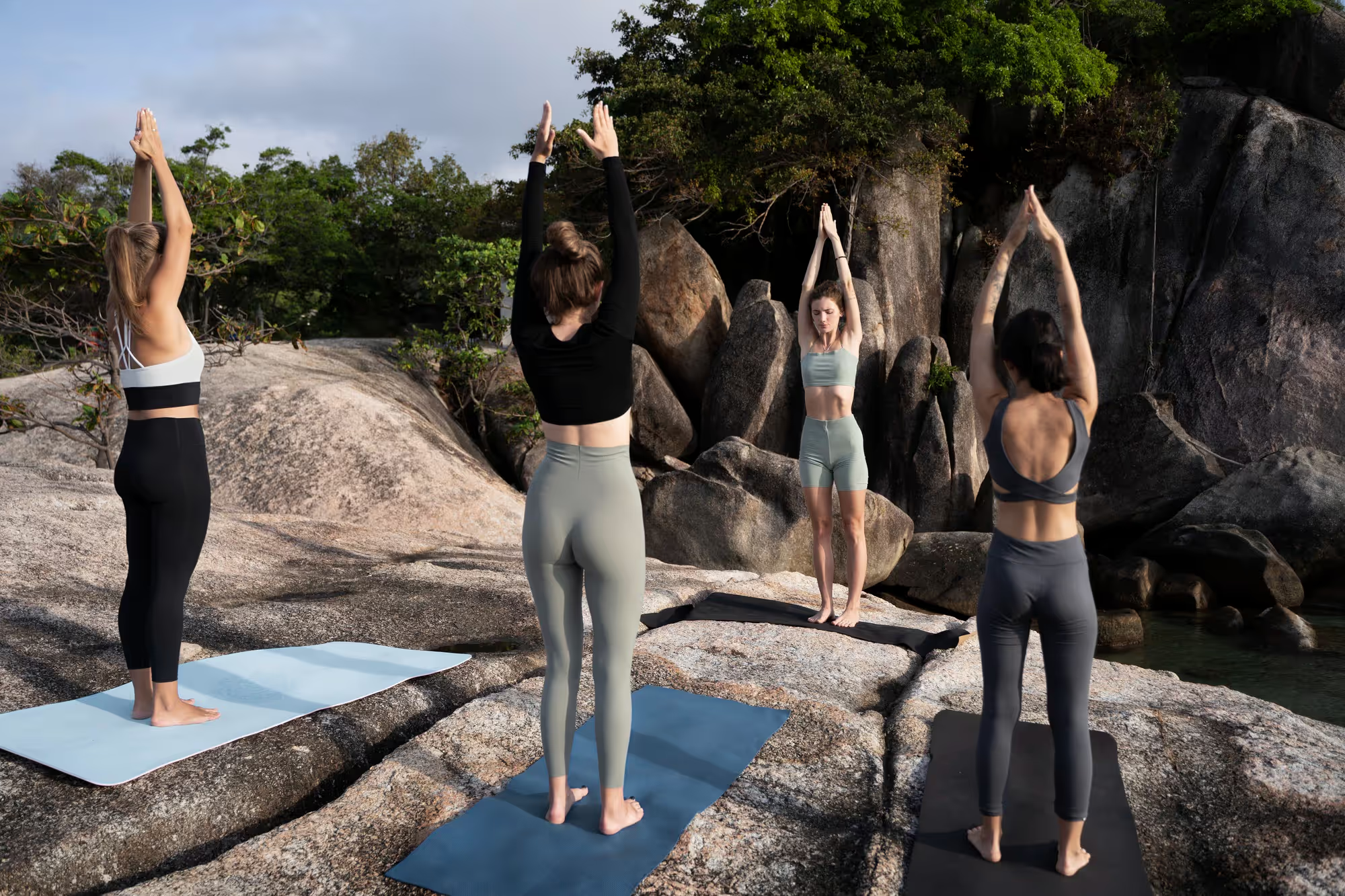
The location of a yoga retreat matters beyond aesthetics. Natural settings—whether coastal, mountainous, forested, or desert—provide specific physiological and psychological benefits that urban or indoor environments cannot replicate, creating conditions that support transformation through mechanisms operating largely beneath conscious awareness.
The research on nature exposure has expanded dramatically over recent decades, with findings consistently demonstrating that time in natural environments reduces cortisol levels, lowers blood pressure, improves heart rate variability, enhances immune function, and promotes psychological well-being across multiple measures. The National Park Service has compiled resources documenting these effects and their implications for public health, supporting their mission to preserve natural spaces as resources for human flourishing beyond mere recreation.
Several mechanisms explain nature's healing effects. Phytoncides—aromatic compounds released by trees and plants—produce documented reductions in stress hormones and improvements in immune function when inhaled during forest exposure. Natural light exposure, particularly morning sunlight, regulates circadian rhythms that artificial lighting disrupts, improving sleep quality and stabilizing mood. The visual complexity of natural environments, characterized by fractal patterns and organic irregularity, produces distinct neurological responses associated with relaxation and attention restoration. Even the sounds of nature—birdsong, water movement, wind through foliage—activate parasympathetic responses that counteract chronic stress.
Retreats situated in natural settings leverage all these mechanisms simultaneously, creating conditions where the body's innate healing capacities can operate without the interference that urban environments continuously impose. The yoga practice itself becomes more accessible when the container holding it already supports nervous system downregulation, and the insights arising from practice integrate more readily when they occur within environments that feel fundamentally safe to the body's ancient threat-detection systems.
The scale of natural environments provides psychological benefits that indoor spaces cannot match. Standing before mountains, gazing across oceans, walking through ancient forests—these experiences invoke what researchers call the "overview effect," a shift in perspective that relativizes personal concerns against larger contexts. Problems that seemed overwhelming in the cramped scale of daily life reveal themselves as manageable when perceived from the vantage point that vast natural beauty provides. This perspective shift does not diminish the reality of challenges but does alter your relationship to them, creating space between stimulus and response where choice becomes possible.
The elemental contact that natural settings provide—feet on earth, skin in sunlight, lungs full of unfiltered air—reconnects you with the physical reality that modern life increasingly mediates through screens, climate control, and artificial surfaces. This reconnection often produces a sense of homecoming that participants struggle to articulate but consistently report, as though some part of themselves that had been living in exile has finally returned to its native environment. The yoga practice, which also works through elemental contact with breath, movement, and bodily sensation, finds natural partnership with environments that support rather than obstruct this embodied presence.
Guided Self-Reflection and Inner Inquiry
Transformation requires not just new experiences but the processing of those experiences into integrated understanding that can inform future action. Many retreats include structured reflection practices—journaling prompts, guided inquiry sessions, intentional silence periods—that support this processing and prevent retreat experiences from remaining isolated episodes that fade quickly upon return to ordinary life.
Journaling at retreat serves different functions than daily journaling might serve at home. The removal from regular context allows you to examine patterns that are invisible when you are embedded within them, seeing your life from a perspective that proximity normally prevents. Questions you would not ask yourself amid the demands of regular days become available when those demands have been temporarily suspended. Insights that would feel self-indulgent or impractical to explore between meetings and errands can receive the attention they require when nothing else competes for your focus.
Silent periods, common in more intensive retreats, amplify the benefits of practice by removing the social performance that conversation requires. When you do not need to present yourself to others—even in the pleasant ways that friendly interaction demands—energy becomes available for internal observation. You notice the constant commentary that normally underlies social interaction, the habitual ways you shape yourself for external perception, the relief that accompanies permission to simply exist without explaining, justifying, or entertaining anyone. This silence frequently proves uncomfortable initially and profoundly restorative eventually.
Facilitated reflection differs from self-directed exploration in that skilled facilitators can notice patterns you cannot see, ask questions you would not think to ask, and hold space for emotional processing that might overwhelm you if undertaken alone. The best yoga retreats employ facilitators trained in psychological support who can guide reflection without imposing interpretations, helping participants access their own wisdom rather than substituting external authority for internal knowing.
The timing of reflection within the retreat schedule matters significantly. Processing sessions placed too early, before practice has created sufficient openness, often remain intellectual rather than embodied. Sessions placed too late may not allow adequate integration before the retreat concludes. Skilled program design distributes reflection throughout the retreat arc, with lighter inquiry earlier and deeper processing in the middle days when participants have developed both the safety and the vulnerability that meaningful self-examination requires.
The content of guided inquiry varies according to retreat philosophy and facilitator training. Some programs emphasize psychological exploration—examining family patterns, relationship dynamics, self-limiting beliefs, and unprocessed experiences that continue influencing present behavior. Others focus on existential questions—meaning, purpose, mortality, and the nature of a well-lived life. Still others employ contemplative inquiry methods drawn from wisdom traditions—self-inquiry in the Advaita Vedanta sense, koan practice from Zen Buddhism, or philosophical investigation in the Socratic tradition. Each approach accesses different dimensions of self-understanding, and the best yoga retreat for your current needs depends partly on which mode of inquiry resonates with your temperament and addresses your growing edges.
Community, Safety, and Shared Intention
The people who gather at yoga retreats share at minimum the intention to step away from ordinary life in search of something—rest, healing, insight, skill development, or simple renewal. This shared intention creates a quality of community that differs markedly from the accidental proximity that characterizes most social groupings, fostering conditions where psychological safety emerges more readily than in environments where competing agendas and defensive posturing dominate interpersonal space.
Psychological safety—the felt sense that one can speak honestly, show vulnerability, and make mistakes without social penalty—has been extensively studied in organizational contexts but applies equally to retreat settings. When participants feel safe, they take the interpersonal risks that growth requires: sharing difficult truths in group discussions, attempting challenging postures without fear of judgment, allowing emotions to arise and express without suppression. This safety does not occur automatically; it must be cultivated through facilitation that establishes clear norms, models appropriate vulnerability, and intervenes when group dynamics threaten to become harmful.
The witnessing function of community accelerates personal insight. When others observe and reflect your patterns, you see yourself through perspectives that your own perception cannot access. The friend who notices that you always apologize before speaking. The teacher who observes that you consistently push through pain signals. The fellow participant who recognizes in your story a pattern they have also struggled with. These external observations, offered within relationships of care and shared purpose, can catalyze recognition that years of solitary reflection might never produce.
Accountability also operates through community. The commitment you make before a group carries different weight than the private promise you make to yourself alone. When others are expecting you at morning practice, you show up. When the group schedule structures your day, you follow it. This external structure supports practice during the phases when internal motivation falters, carrying you through resistance into the deeper benefits that lie beyond initial discomfort.
— Ava Mitchell
The diversity present in most retreat groups expands your understanding of human possibility in ways that homogeneous social circles cannot. You encounter people from different professions, life stages, geographic origins, and philosophical orientations, each bringing perspectives that challenge your assumptions and expand your sense of how lives can be constructed. The executive who has discovered that achievement cannot fill inner emptiness. The artist who has found in yoga a discipline that supports rather than constrains creativity. The retiree who is finally exploring the inner life that decades of external focus postponed. Each story adds to your understanding of the human condition and your sense of the possibilities available within it.
The bonds formed during retreat often prove surprisingly durable despite the limited time of their formation. The intensity of shared experience creates connection that weeks of casual acquaintance might not produce. Participants frequently describe retreat friendships as among the most meaningful in their lives, characterized by a depth and authenticity that ordinary social contexts rarely support. These relationships extend the retreat's benefits forward in time, providing ongoing support for the practices and perspectives that the retreat initiated.
Medical Wellness: The Modern Evolution of Yoga Retreats
Contemporary yoga retreats increasingly integrate elements of medical wellness that complement traditional practices with evidence-based interventions drawn from clinical settings. This evolution reflects growing recognition that the separation between "wellness" and "medicine" serves neither category well, and that combining contemplative traditions with scientific understanding produces outcomes that neither approach achieves independently.
Medical wellness components appearing in modern retreats include several categories of intervention:
- Stress recovery protocols that combine yoga practices with biofeedback, heart rate variability training, or other technology-supported approaches to nervous system regulation, allowing participants to track physiological changes and refine practices based on objective data rather than subjective impression alone.
- Mobility therapy and movement assessment conducted by physical therapists or movement specialists who can identify compensatory patterns, address chronic restrictions, and provide personalized modifications that make yoga practice safer and more effective for individual bodies with individual histories.
- Sleep optimization through circadian rhythm education, sleep environment design, and behavioral interventions that address the epidemic of insufficient and poor-quality sleep that undermines health across virtually every biological system.
- Evidence-based wellness education that helps participants distinguish between practices supported by robust research and those marketed primarily through testimonial and tradition, empowering informed decision-making about which interventions to continue post-retreat.
The Cleveland Clinic has developed integrative wellness programming that exemplifies this synthesis, combining conventional medical expertise with complementary approaches including yoga, meditation, and lifestyle medicine. Similar models increasingly inform retreat design, creating experiences that honor traditional practices while incorporating scientific advances that enhance safety, efficacy, and accessibility.
The best yoga retreat experiences thoughtfully integrate these medical wellness elements rather than treating them as separate tracks or optional add-ons. When movement therapy informs yoga instruction, and yoga practice supports stress recovery protocols, and nutrition education connects to digestive wellness experienced through retreat meals, the result is a coherent system rather than a collection of disconnected interventions competing for participant attention and belief.
This integration requires faculty collaboration that many retreats have not yet achieved. When the yoga teacher, the nutritionist, the movement therapist, and the meditation instructor operate independently, participants must do the work of synthesis themselves—often without the knowledge necessary to recognize connections or resolve apparent contradictions between different approaches. Programs where faculty collaborate in design and communicate during delivery produce more coherent experiences that allow participants to focus on their own process rather than on managing conflicting expert opinions.
— Ava Mitchell
The growing emphasis on medical wellness also reflects demographic shifts in retreat participation. As yoga has moved from countercultural fringe to mainstream acceptance, retreat participants increasingly include people managing chronic conditions, recovering from illness or injury, or seeking prevention-focused health optimization rather than spiritual transformation. These participants need programming that addresses their specific circumstances with the precision that traditional approaches, designed for healthy young practitioners, often lack. Medical wellness integration meets these needs while maintaining the contemplative core that distinguishes yoga retreats from spa vacations or fitness camps.
Choosing the Best Yoga Retreat for Your Needs
The question of which retreat is "best" has no universal answer because retreat selection depends entirely on individual circumstances, goals, and preferences. The retreat that transforms one person's life might bore another or overwhelm a third. Thoughtful selection requires honest assessment of what you actually need and careful evaluation of whether specific offerings align with those needs.
Teaching style represents perhaps the most important variable. Some traditions emphasize precise alignment and detailed instruction; others prioritize flow and intuition. Some teachers lead with warmth and encouragement; others employ intensity and challenge. Your response to different teaching approaches depends on your own psychology, your practice history, and what kind of guidance currently serves your growth. Reading reviews, watching teacher videos, and attending local classes taught by retreat leaders when possible all help assess fit before committing to extended immersive experience.
Retreat intensity ranges from gentle and restorative to demanding and intensive. A retreat featuring three daily practice sessions plus workshops plus evening programming suits experienced practitioners seeking breakthrough but may overwhelm beginners or those recovering from exhaustion who need rest more than achievement. Conversely, a gentle retreat with ample free time might frustrate practitioners seeking rapid skill development or those who need structure to prevent their minds from filling empty space with the worries they came to escape.
Wellness focus varies according to retreat philosophy and faculty expertise. Some retreats emphasize physical practice almost exclusively. Others center meditation and contemplative inquiry. Still others integrate nutrition, sleep optimization, stress recovery, and other medical wellness components into comprehensive programs addressing the full spectrum of factors that influence well-being. Clarity about your own priorities helps identify programs whose emphasis matches your current needs.
Accommodation ranges from rustic simplicity to luxury comfort. Neither choice is inherently superior—the question is what environment supports your practice and psychological state. Some people find that simple surroundings reduce distraction and encourage turning inward. Others find that physical discomfort or environmental deprivation impairs their capacity for the openness that retreat work requires. Know your own relationship with comfort and choose accordingly.
Group size dramatically affects retreat experience. Large retreats offer more diversity in relationships and perspectives but less individual attention and more potential for feeling lost in crowds. Small retreats provide intimacy and personalized instruction but less variety in community and sometimes uncomfortable intensity of social exposure. Consider your own social preferences and how group dynamics tend to affect your internal process.
Harvard Health Publishing discusses the importance of matching wellness interventions to individual needs and readiness, principles that apply directly to retreat selection. The best yoga retreat is not objectively determined but rather subjectively appropriate—aligned with your current state, your growth edges, and your capacity to receive what the experience offers.
Geographic considerations extend beyond scenic preference to include practical factors like travel fatigue, climate adjustment, and time zone disruption. A retreat requiring twenty hours of travel and significant jet lag adjustment may consume days of recovery time that could otherwise support practice. Closer options, while perhaps less exotic, allow you to arrive rested and present rather than spending the first days recovering from the journey itself.
The reputation and credentials of retreat leadership deserve careful investigation. The yoga world unfortunately includes practitioners whose teaching exceeds their training, whose charisma masks lack of substance, or whose ethical boundaries prove inadequate to the power that retreat settings confer. Checking credentials, reading reviews from multiple sources, and trusting your intuition about people and programs all help protect against experiences that range from merely disappointing to actively harmful.

Author: Ava Mitchell;
Source: yogapennsylvania.com
Common Misconceptions About Yoga Retreats
Several persistent myths discourage people who might benefit enormously from retreat experience, creating barriers to participation that dissolve immediately upon examination but that nonetheless prevent initial consideration.
The belief that retreats require advanced practice keeps many beginners away from experiences specifically designed to welcome them. While some retreats do assume significant prior experience, many are explicitly designed for newcomers, offering instruction that builds from fundamentals and creating environments where inexperience carries no stigma. The immersive nature of retreat learning actually accelerates skill acquisition, making retreats excellent choices for beginners willing to invest in concentrated practice rather than gradual accumulation over years of weekly classes.
The assumption that retreats are exclusively spiritual alienates those who prefer secular approaches to wellness. Contemporary retreats span the full spectrum from traditionally devotional to entirely secular, with many occupying middle ground that respects contemplative traditions without requiring adherence to particular metaphysical beliefs. Participants can typically find programs aligned with their own relationship to spirituality, whether that involves deep devotional practice, psychological rather than spiritual framing, or something in between.
The fear that retreats are physically exhausting prevents rest-seeking individuals from accessing experiences that might provide exactly the restoration they need. Many retreats explicitly center rest and renewal, featuring gentle practice, ample free time, and programming designed to discharge accumulated stress rather than add new demands. The retreat category encompasses such variety that generalizations about physical intensity fail entirely—evaluation must occur at the level of specific programs rather than the retreat concept itself.
The concern about cost accessibility, while often valid, sometimes prevents exploration of genuinely affordable options. Retreat pricing ranges enormously, and many programs offer work-exchange arrangements, scholarships, or sliding-scale options that make participation possible at various economic levels. Additionally, the concentrated benefit of retreat experience sometimes justifies investment that seems significant compared to individual class fees but appears reasonable when evaluated against the cumulative cost and limited impact of years of sporadic practice.
The worry about social awkwardness—being surrounded by strangers, navigating unfamiliar group dynamics, potentially encountering people whose personalities clash with your own—keeps some potential participants home. While social discomfort can certainly arise, retreat environments typically establish norms that reduce social pressure and create space for varying levels of engagement. You can usually participate fully in programming while maintaining whatever degree of social distance feels comfortable, and the shared intention that brings people to retreat tends to produce more goodwill and less judgment than ordinary social contexts.
Integration: Bringing Retreat Insights Home
The transformation that occurs during retreat remains vulnerable until integration anchors new patterns into daily life. The altered state accessible within retreat conditions does not automatically transfer to ordinary circumstances; without intentional integration, retreat benefits often fade within weeks as old environments reactivate old patterns and the memory of retreat presence becomes increasingly abstract and inaccessible.
Integration begins with realistic planning before retreat ends. What specific practices will you continue? When will they occur? What environmental modifications will support them? What relationships might you engage to provide accountability and encouragement? These practical questions deserve serious attention during the final days of retreat, when the felt sense of what serves you remains vivid and the gap between current state and ordinary life remains visible.
Modest goals support sustainable integration better than ambitious overhauls that collapse under real-world pressure. The three-minute daily meditation you actually do produces more benefit than the hour-long practice you abandon after a week. The single dietary change that sticks creates more impact than the comprehensive nutritional overhaul that proves incompatible with your household, schedule, or social context. Choose practices you are highly confident you will maintain, recognizing that successful maintenance opens space for gradual expansion while failed ambition creates discouragement that may prevent any practice whatsoever.
Environmental design significantly influences integration success. Remove obstacles to practice: establish a designated space, gather necessary props, set up reminders, communicate your intentions to household members who might otherwise unknowingly interfere. Add obstacles to patterns you wish to change: remove convenient triggers, establish friction that requires conscious choice rather than automatic behavior. Your environment shapes behavior more powerfully than willpower; design it accordingly.
Community support extends retreat relationships into ongoing accountability and inspiration. Many participants maintain contact with retreat companions, creating informal support networks that provide encouragement during difficulty and celebration during progress. Some retreat programs offer post-retreat integration sessions, check-in calls, or online communities that maintain connection and extend facilitated support beyond the retreat container. These relationships carry the retreat's transformational potential forward in time, reminding you of the self you contacted during practice and providing witnesses who hold you accountable to your own expressed intentions.
The rhythm of integration typically involves initial enthusiasm followed by gradual erosion as ordinary demands reassert themselves, followed either by abandonment or by recommitment at a more realistic level. Anticipating this rhythm helps you navigate it without catastrophizing the inevitable dips or using temporary setbacks as justification for complete abandonment. The practice that survives integration is rarely identical to the practice imagined during retreat's final days—it has been modified, reduced, adapted to fit real circumstances—but it maintains the essential connection to what retreat experience revealed.
Periodic return to retreat settings—whether the same program or different ones—supports long-term maintenance by refreshing the felt sense of what practice can provide and by creating external structure that compensates for the internal discipline that ordinary life erodes. Many experienced practitioners build annual or semi-annual retreats into their lives as essential rather than optional, recognizing that the concentrated practice these settings provide cannot be fully replaced by daily sessions alone, no matter how consistent.
— Ava Mitchell
The Ongoing Invitation of Transformational Practice
The yoga retreat, when approached with clarity of intention and openness to experience, offers something that ordinary life rarely provides: conditions optimized for change. The removal from habitual environment, the immersion in daily practice, the nourishment of body through considered nutrition, the healing influence of natural settings, the safety of intentional community, and the integration of contemplative tradition with contemporary medical wellness—these elements combine to create transformation that exceeds what their sum might suggest.
This transformation operates not through magic but through mechanism, through the convergence of factors that neuroscience, psychology, and physiology are increasingly able to articulate. Your nervous system responds to the conditions you provide it. Your attention develops through the training you undertake. Your patterns reveal themselves when habitual triggers are removed, and new patterns establish themselves when repetition and environment support their formation. The retreat creates conditions; your presence and practice within those conditions creates change.
The best yoga retreat for your particular circumstances awaits your discernment—an experience aligned with your current state, responsive to your growth edges, and designed with the integrity that genuine transformation requires. Finding it requires honest self-assessment, careful research, and willingness to invest in yourself through the commitment of time, resources, and openness that transformational experience demands.
The invitation extends beyond any single retreat to an ongoing relationship with practice that retreat experience can initiate but cannot complete. Transformation is not an event but a process, not a destination but a direction, not something you achieve once and possess forever but something you cultivate continuously through the choices you make about how to spend your attention and your time. The retreat offers a glimpse of what becomes possible when conditions support practice; your life provides the arena where that possibility either manifests or fades.
And after the retreat ends, after you return to ordinary life with its ordinary demands and ordinary distractions, the question becomes what you will maintain, what you will integrate, what you will carry forward from the container that held your practice into the life that receives you back. Transformation is not what happens during retreat—it is what remains after. The practices you continue. The patterns you have shifted. The self-understanding you have gained and the compassion you have developed. These persist beyond the retreat container, becoming not memories of who you briefly were but expressions of who you are becoming through the ongoing practice that retreat experience initiated and that your daily commitment sustains.
The mat you unroll tomorrow morning, in whatever room you have designated for practice, extends from the mat you occupied during retreat. The breath you follow into stillness connects to the breath you discovered when external conditions first allowed you to notice its constant presence. The self you are becoming—more present, more resilient, more capable of meeting life's inevitable difficulties with equanimity and grace—emerges from the self who first decided that transformation was worth pursuing and that a yoga retreat might be the container within which such transformation could begin. That decision, made perhaps tentatively, perhaps skeptically, perhaps desperately, opens into a path that stretches forward indefinitely, always offering the next step, always inviting deeper practice, always revealing more of what becomes possible when you commit yourself fully to the endless, rewarding work of waking up.
FAQ
Related Stories
Read more
Read more



The content on yogapennsylvania.com is provided for general informational and inspirational purposes only. It is intended to share yoga tips, meditation practices, wellness guidance, retreat experiences, and lifestyle insights, and should not be considered medical, therapeutic, fitness, or professional health advice.
All information, articles, images, and wellness-related materials presented on this website are for general informational purposes only. Individual health conditions, physical abilities, wellness goals, and experiences may vary, and results can differ from person to person.
Yogapennsylvania.com makes no representations or warranties regarding the accuracy, completeness, or reliability of the content provided and is not responsible for any errors or omissions, or for decisions or actions taken based on the information presented on this website. Readers are encouraged to consult qualified healthcare or wellness professionals before beginning any new yoga, meditation, or fitness practice.